
I intend for this to be a good start point/launchpad to have a general understanding and overview of secondary school with its different programmes and post secondary school paths in Singapore.
Please check the schools’ official website to verify important details as things may change. I strive to be 100% accurate. Please let me know if there is any errors and i will update asap.
I add in some commentary to aid parents in better understanding the various options besides just providing numbers. Please note my opinions are subjective.
For the pdf version, please click here
Overview of Content Covered
Secondary School
—–>Subjects offered in secondary school
—–>Grading system
—–>Financial matters
—–>Unique differences between schools
—–>Different paths in Secondary school
———->1) if you enter Normal Technical
———->2) if you enter Normal Academic
—————>Polytechnic Foundation Programme (PFP)
—————>Direct entry scheme to polytechnic (DPP)
———->3) if you enter Express
—————>Early Admissions Exercise (EAE)
—————>Direct School Admission for sec sch (DSA-JC)
———->4) if you enter Integrated Programme (IP)
———->5) International Baccalaureate (IB) diploma
———->6) NUS High
———->7) Singapore Sports School
———->8) School of Science and Technology, Singapore
———->9) School of the Arts (SOTA)
—–>New: subject based banding
Post Secondary School
—–>Possible Paths after secondary school
—–>1) Institute of Technical Education (ITE)
—–>2) Polytechnic
—–>3) Junior College
—–>4) International Baccalaureate (IB) diploma
—–>5) La Salle & Nanyang Academy of Fine Arts (NAFA)
—–>Comparison between JC, Poly and IB
Secondary School
- Secondary school is generally 4 years where your class stays the same from year 1 to 2 and year 3 to 4.
- Secondary 2 is a crucial year as the school determines the subjects you take in upper secondary based on your results in sec 2. It is relatively less important for top schools students in the sense that everyone will still take the same subjects, unless you want to take more subjects than the average student workload.
- Personally, i think additional maths is an important subject to take as it trains your thinking and logical skills and is relevant if you go on to study finance/engineering/IT/science. Different schools have different requirement for different subjects, school will have parent teacher conference to inform them of the specifics in year 2.
- In upper secondary, an average student in express stream take 7-8 subjects. Students in the N(A) stream take around 5-8 subjects and students in the N(T) stream take around 5-7 subjects. Top students can take up to 11 O levels subjects.
- If you did extremely bad in your overall results, school might make the decision to retain you and repeat the year. However, if you are in year 4, there is no chance of retaining and redoing the national examination again if you did badly (N/O level). You would have to leave school and retake (N/O level) as a private candidate if you choose to.
Example of a list of subjects taken by a student will be (english, chinese, mathematics, combined physics/chemistry, combined social studies/history, principle of account)
Subjects offered in secondary school
Schools do not offer all subjects available for O levels. For example, only 32 out of 136 schools offered computing. Generally top schools do not offer Nutrition and Food Science, Design & Technology and Principle of Account among others.
- English
- Mother tongue (chinese, malay, tamil)
- Higher mother tongue (chinese, malay, tamil)
- 3rd language taught by external centres (french, german, japanese, spanish, arabic, bahasa indonesia, chinese, malay)
- Additional Maths
- Mathematics
- Combined humanities (treated as 1 subject, half is Social Studies, other half elective history/geography/literature)
- Pure Geography
- Pure History
- Pure English Literature
- Literature in (Chinese, Malay, Tamil)
- Computing
- Design & Technology
- Electronics
- Nutrition and Food Science
- Pure Biology
- Pure Chemistry
- Pure Physics
- Combined Science (treated as 1 subject, half of the syllabus is chemistry, other half either physics/biology)
- Art
- Music
- Drama
- Principle of Account
Students can elect to drop certain subjects if they find it hard to cope and wish to focus on fewer subjects for examinations but it is not possible to study additional subjects in sec 3 or 4.
Personal Opinion: Physics tend to be more useful than studying Biology as the knowledge/concepts are crucial for science/engineering but ultimately students should pick based on their interests.
You can still study biology for A levels if you did not take biology for O levels.
A level biology is not a hard requirement to study medicine in NUS.
Grading system
General system adopted by most secondary schools
Grading for Ordinary levels
| Score | Grade | Points |
| 75-100 | A1 | 1 |
| 70-74 | A2 | 2 |
| 65-69 | B3 | 3 |
| 60-64 | B4 | 4 |
| 55-59 | C5 | 5 |
| 50-54 | C6 | 6 |
| 45-49 | D7 | 7 |
| 40-44 | E8 | 8 |
| 35-39 | F9 | 9 |
Grading for Normal Level
| Score | Grade |
|---|---|
| 75-100 | 1 |
| 70-74 | 2 |
| 65-69 | 3 |
| 60-64 | 4 |
| 50-59 | 5 |
| <49 | 6 |
Grade Mapping Table (O to N levels)
| Score | Grade |
|---|---|
| A1, A2, B3 | 1 |
| B4, C5, C6 | 2 |
| D7 | 3 |
| E8 | 4 |
| 9 | 5 |
| – | 6 |
As of 2023, MOE removed mid year examinations for all secondary 1 and 3 students.
Do note that your child do not need to excel in all subjects to enter a good school. Junior colleges look at your best 6 subjects (specific requirements explained in another section) while Polytechnic look at your best 5 subjects (specific requirements explained in another section)
English and Mathematics are highly crucial subjects. If student fails either (D7 and below), it will be almost impossible to enter either polytechnic or junior college even if rest of your subjects did very well.
Other schools use other systems
GPA table for Raffles Girls’ School and Raffles Institution (Secondary)
| Grade | Percentage | Grade Point |
|---|---|---|
| A+ | 80-100 | 4.0 |
| A | 70-79 | 3.6 |
| B+ | 65-69 | 3.2 |
| B | 60-64 | 2.8 |
| C+ | 55-59 | 2.4 |
| C | 50-54 | 2.0 |
| D | 45-49 | 1.6 |
| E | 40-44 | 1.2 |
| F | 0-40 | 0.8 |
Hwa Chong Institution, St. Joseph’s Institution, School of Science and Technology, and Victoria School (Express) use a similar grading system called the Mean Subject Grade (MSG). The MSG table works similarly to the regular grading scheme, with the number prefix being the determinant for the points; like in GPA, the points are calculated by average to the number of subjects taken, rounded to two decimal points.
Financial matters
Check this website https://www.moe.gov.sg/financial-matters/fees
government schools are roughly sgd 25/mth while independent schools can be sgd 300-600/mth
Unique differences between schools
One key difference between schools are single gender (12 boys schools, 15 girls schools) vs most schools (121 schools) which are co-ed (both male and female students).
Co-curricular activity (CCA) are compulsory at the secondary school level.
There are 4 general groups Clubs and Societies, Physical Sports, Uniformed Groups, Visual and Performing Arts
Some schools have unique co-curricular activity (CCA) that are unavailable in other schools. For example, only Regent secondary school and Queenstown secondary school have Equestrian (Horse-riding) Club
https://smiletutor.sg/want-an-extraordinary-cca-for-secondary-school-here-are-5-that-you-might-not-have-thought-of/
Christchurch secondary school has a 4 day school week with academic lessons only on monday to thursday and friday is CCA day
https://mothership.sg/2019/03/christ-church-secondary-school-four-day-lesson-week/
Hwa Chong Institution have a Malay Special Programme where all students have to study Malay language in secondary 2
Do message me if your school has something unique not mentioned here!
Different paths in Secondary school
Normal technical stream
Normal academic stream
Express stream
Integrated programme (IP)
International Baccalaureate (IB) diploma
NUS high
Singapore Sports School
School of Science and Technology, Singapore
School of the Arts (SOTA)
1) if you enter Normal Technical
you study and take N(T) level examinations in 4 years and go on to ITE
*There are also Specialised Schools for Normal (Technical) Students.
Crest Secondary School and Spectra Secondary School cater to students who are eligible for the N(T) course and prefer a more hands-on and skill-based learning experience.
NorthLight School and Assumption Pathway School cater to students who are not eligible for the N(T) stream based on their PSLE performance. Students graduate from these two schools with the ITE Skills Certificate (ISC), which prepares them for employment or admission into ITE.
2) if you enter Normal Academic
You study and take N(A) level examinations in 4 years
after which there are 3 paths
1) continue for one more year in same secondary school to study additional topics not covered in N levels and take O levels in the 5th year
2) Polytechnic Foundation Programme (PFP)
if you do very well for N levels, you can enter PFP where you will do a one year preparatory programme in poly and be granted a provisional place in a diploma programme at the start of the PFP.
Requirement: ELMAB3 equals or below 12 and english must be grade 2 or 3 (depending on course)
3) go on to ITE
2 options
do a 3-year higher Nitec course or apply for
Direct entry scheme to polytechnic (DPP)
It allows Secondary 4 N(A) students to be admitted directly into a 2-year Higher Nitec programme at the Institute of Technical Education (ITE) and a position in polytechnic subsequently
requirement: ELMAB3 equals or below 19
more information in https://www.moe.gov.sg/post-secondary/admissions/dpp
3) if you enter Express
you take O level examinations in 4 years which you will subsequently use the results to apply for Joint Admissions Exercise (JAE) in mid january
Programmes you can take advantage of to make examinations less stressful
Early Admissions Exercise (EAE)
- It allows the polytechnics greater flexibility to select and admit students based on their aptitudes and interests, apart from academic grades
- The 5 polytechnics generally set aside 20% of their intake for EAE. Certain courses such as Early Childhood, Social Work, and Design have allowance of 50% for aptitude-based admissions
- Application starts june and notification of offer usually is early september where you decide to accept or withdraw
- You can pick up to 3 courses for EAE
- You can apply for both EAE for poly and DSA-JC Exercise concurrently but you can only accept one offer if you are successful for both
- Selection test varies based on course chosen and include portfolios, aptitude tests, and interviews. Students can visit the respective institutions’ websites to find out more about the expectations of the EAE selection process for the different courses
- Once you accept the conditional offer, you will not be able to change your mind and participate in Joint Admissions Exercise (JAE) although you can appeal directly to the junior college (low probability)
Once you accept conditional offer, you just need to achieve
1) A net ELR2B2 score of 26 points or better for the GCE O-Level examinations
(roughly an average of C5 for your 5 subjects)
2) different courses have different Minimum Entry Requirements (MERs)
EL: English Language
R2: 2 relevant subjects for the polytechnic course applied for
B2: 2 other best subjects which could be elective subjects
Courses with up to 50% intake through EAE found at bottom of page
https://eae.polytechnic.edu.sg/eaeStudIns/menu.jsp?type=FAQs#g13
Direct School Admission for sec sch (DSA-JC)
- If you are admitted to a school through DSA-JC, you cannot participate in the Joint Admissions Exercise (JAE) or transfer to another school. You must commit to your chosen school for the duration of the programme.
- You can apply for both EAE for poly and DSA-JC Exercise concurrently but you can only accept one offer if you are successful for both
- Application starts mid may and phase 1 outcome is in july/august and phase 2 outcome is in august/september and receive your DSA-JC school allocation outcome through email on the afternoon of O-Level results release in January
To be eligible for admission to a junior college (JC) course via JAE or DSA-JC, you must meet these 2 criteria:
1) Your L1R5 gross aggregate score must not exceed 20.
2) Meet the grade requirements for specific subjects.
| L1R5 | Subjects |
| L1 | English or Higher Mother Tongue Language |
| R1 | Any 1 best-scoring subject from Humanities |
| R2 | Any 1 best-scoring subject from Mathematics or Science |
| R3 | Any 1 best-scoring subject from Humanities, Mathematics or Science |
| R4, R5 | Any 2 best-scoring subjects except Religious Knowledge |
You cannot use:
1) The grades of Higher Mother Tongue Language and Mother Tongue Language in the same aggregate computation. For example, if Higher Chinese is used as the first language (L1), Chinese cannot be used as a relevant subject (R4 or R5).
2) “Merit” and “Pass” grades for the Mother Tongue ‘B’ Syllabus for aggregate computation.
Grade requirements for specific subjects
| Subject | Grade |
| English Language | 1-6 |
| Any 1 Mathematics Additional Mathematics Mathematics | 1-7 |
| Any 1 Mother Tongue Language (MTL) MTL: Chinese, Malay, Tamil MTL approved by MOE in lieu of an official MTL (MTL-in-lieu): Arabic, Bengali, Burmese, French, German, Gujarati, Hindi, Japanese, Punjabi, Thai, Urdu | MTL or MTL-in-lieu: 1-7 Higher MTL: 1-8 ‘B’ Syllabus: Merit or Pass Note: There is no Higher level or ‘B’ Syllabus for MTL-in-lieu. |
Criteria for conditional admission
If you have sat for the subject but did not obtain the minimum grade stated above, you are eligible for conditional admission when you meet one of these criteria:
-L1R5 gross aggregate score ≤ 15
-L1R5 gross aggregate score from 16 to 20, and have grades of A1 or A2 in all the 5 relevant subjects
You must re-sit for the subject and obtain the required grade by the end of Year 1 in JC. If you fail to do so, you will be transferred to Year 2 of a course in Millennia Institute (MI).
By the end of Year 2 in MI, if you still do not obtain the required grade, you have to leave the MI course.
More information can be found here https://www.moe.gov.sg/post-secondary/admissions/dsa
2 concerns of entering junior college through DSA
Your JC would expect you to represent them in whatever activity you DSA through, failing which they reserve the right to kick you out.
Would you be able to cope academically? The teaching style and pace would be designed for the top scorers in PSLE and O Levels.
4) if you enter Integrated Programme (IP)
The secondary schools partner a junior college (JC) to jointly offer the programme. IP students can gain admission to their secondary school’s JC partner without having to take the Singapore-Cambridge GCE Ordinary Level (O-Level) examination. You take A level examinations in 6 years.
*it is not a guaranteed path, these schools will continue to have school-based assessments to measure pupils’ progress. If you do not do well, school will drop you to rejoin the O level stream in the same school, and you can rejoin IP programme after if your results improve
schools offering integrated programme
| School | Length of Programme | JC Partner |
|---|---|---|
| Catholic High School | 4 years + 2 years at JC Partner | Eunoia JC |
| CHIJ St. Nicholas Girls’ School | 4 years + 2 years at JC Partner | Eunoia JC |
| Singapore Chinese Girls’ School | 4 years + 2 years at JC Partner | Eunoia JC |
| Dunman High School | 6 Years | – |
| Nanyang Girls’ High School | 4 years + 2 years at JC Partner | Hwa Chong Institution |
| Hwa Chong Institution (Secondary) | 4 years + 2 years at JC Partner | Hwa Chong Institution |
| National Junior College (Secondary) | 6 Years | – |
| Raffles Girls School | 4 years + 2 years at JC Partner | Raffles Institution |
| Raffles Institution (Secondary) | 4 years + 2 years at JC Partner | Raffles Institution |
| River Valley High School | 6 Years | – |
| Temasek Junior College (Secondary) | 6 Years | – |
| Victoria School | 4 years + 2 years at JC Partner | Victoria Junior College |
| Cedar Girls’ Secondary School | 4 years + 2 years at JC Partner | Victoria Junior College |
5) International Baccalaureate (IB) diploma
6 year programme
Here is the complete list of IB schools: ACS (International) Singapore; Anglo-Chinese School (Singapore); Canadian International School; Dulwich College (Singapore); Chatsworth International School; Dover Court International School; Eton House International School; GESS; Global Indian International School; Hillside World Academy; Hwa Chong International School; NPS International School; Nexus International School (Singapore); Joseph’s Institution International; School of the Arts (Singapore); Stamford American School; Singapore Sports School; Tanglin Trust School; UWC South East Asia.
final IB exams account for about 70% to 80% of the total mark for each subject, while assignments assessed by teachers and checked by external examiners contribute the rest of the final grade.
IB coverage is more extensive, but the final exams tend to be less challenging than the A levels.
IB have a greater emphasis on group/project work which is assessable compared to A levels.
Students take the examinations together with other students from all over the world and Singaporean students do very well in comparison, many scoring perfect grades for the diploma.
https://www.straitstimes.com/singapore/parenting-education/ib-results-singapore-excels-with-nearly-half-of-perfect-scorers-worldwide
https://www.straitstimes.com/singapore/ib-results-singapore-continues-to-excel-and-surpass-global-average
6) NUS High
ideal for students with very strong aptitude and inclined towards in mathematics and science
Affiliated with the National University of Singapore (NUS), which allows for a direct connection to university resources, faculty, and opportunities for advanced research projects.
graduate with a NUS high diploma in 6 years
small cohort of roughly 170 students every year
most students enter through DSA (5 rounds of test & interview)
students tend to be in the leadership board in most academic related competitions
NUS high diploma is recognized both locally and internationally, there should be no problem applying to the most prestigious universities as well
7) Singapore Sports School
Specializes in Athletics & Sports
They offer nine Academy Programme sports: Badminton, bowling, fencing, football, netball, shooting, swimming, table tennis, and track and field.
They also work closely with the National Sports Associations to nurture student-athletes in sports such as artistic swimming, diving, golf, gymnastics, ice skating, pencak silat, water polo, wushu, and more.
Offers a few options
1) GCE O and N Levels Examinations
2) International Baccalaureate Diploma Programme
3) customised Diploma in Business (Sport Management Track) from Republic Polytechnic or the customised Diploma in Business Studies (Entrepreneurship Management Option) from Ngee Ann Polytechnic
students can join in sec 1 or join mid-stream between sec 2 or 3 or join in sec 4 and 5 using Direct School Admission-Junior Colleges (DSA-JC) Exercise or Polytechnic Early Admissions Exercise (EAE) if they are interested in the International Baccalaureate Diploma or Polytechnic Diploma respectively
8) School of Science and Technology, Singapore
Relatively new school, pioneer batch was 2010-2013
It operates under the Ministry of Education and is part of the regular school system in Singapore, focusing on providing a well-rounded education with an emphasis on science and technology.
Entry requirement: It admits ALL our Secondary 1 students through the Direct School Admission Secondary (DSA-Sec) exercise. It does not participate in the MOE Secondary One Posting Exercise. The DSA consists of 2 parts, Phase 1 is a 2 hours Written Test to test candidates’ ability to solve real-world problems by applying STEM knowledge and skills. Phase 2 STEAM Challenge is an activity-based assessment where candidates will work in groups to solve real-world issues.
SST is special for its Applied Subjects, which are special “O” levels subjects typically run by its partner polytechnics, for example computing, electronics, biotechnology, design studies
offers GCE O levels in 4 years and also a direct through train to Ngee Ann Polytechnic STEAM (Science, Technology, Engineering, Aesthetics, and Mathematics) related diploma
9) School of the Arts (SOTA)
Emphasis on the arts such as music, dance, or theatre
Small cohort with at most 180 students
Like SST, It does not participate in the MOE Secondary One Posting Exercise. Entry is via DSA-Secondary
Offers a 6 years International Baccalaureate Diploma Programme (IBDP) or
a 6 years International Baccalaureate Career-related Programme (IBCP) for students in Years 5 and 6 who intend to pursue a professional arts pathway.
Picking SOTA doesn’t mean that student is pigeonholed into doing only arts, in fact over 70% of its graduates have gone on to pursue non-arts related university courses
https://www.straitstimes.com/singapore/education/more-sota-students-go-on-to-pursue-non-arts-related-fields
Supposedly school hours tend to be longer than normal secondary school based on feedback from SOTA students on reddit
New: subject based banding
As of 2024, Ministry of Education (MOE) introduce Full Subject Based Banding System for secondary 1 cohort
G1, G2, G3 subjects are simply different naming for the original normal technical, normal academic, express stream respectively
Rationale: to remove stigma between the different streams and allow more flexibility to do subjects you are good at at a higher level and less strong subjects at a reduced difficulty
https://www.moe.gov.sg/microsites/psle-fsbb/full-subject-based-banding/main.html
Post Secondary School
Possible Paths after secondary school
1) Institute of Technical Education (ITE)
2) polytechnics
3) junior college
4) International Baccalaureate (IB) diploma
5) School of the Arts (SOTA)
6) Lasalle & Nafa
1) Institute of Technical Education (ITE)
you go on to either 3 year Nitec course or 4 year higher Nitec course (2year nitec, 2year higher nitec)
by 2026, all courses will be 3 years leading to Higher Nitec
https://www.straitstimes.com/singapore/parenting-education/shorter-route-to-higher-nitec-for-all-ite-students-by-2026
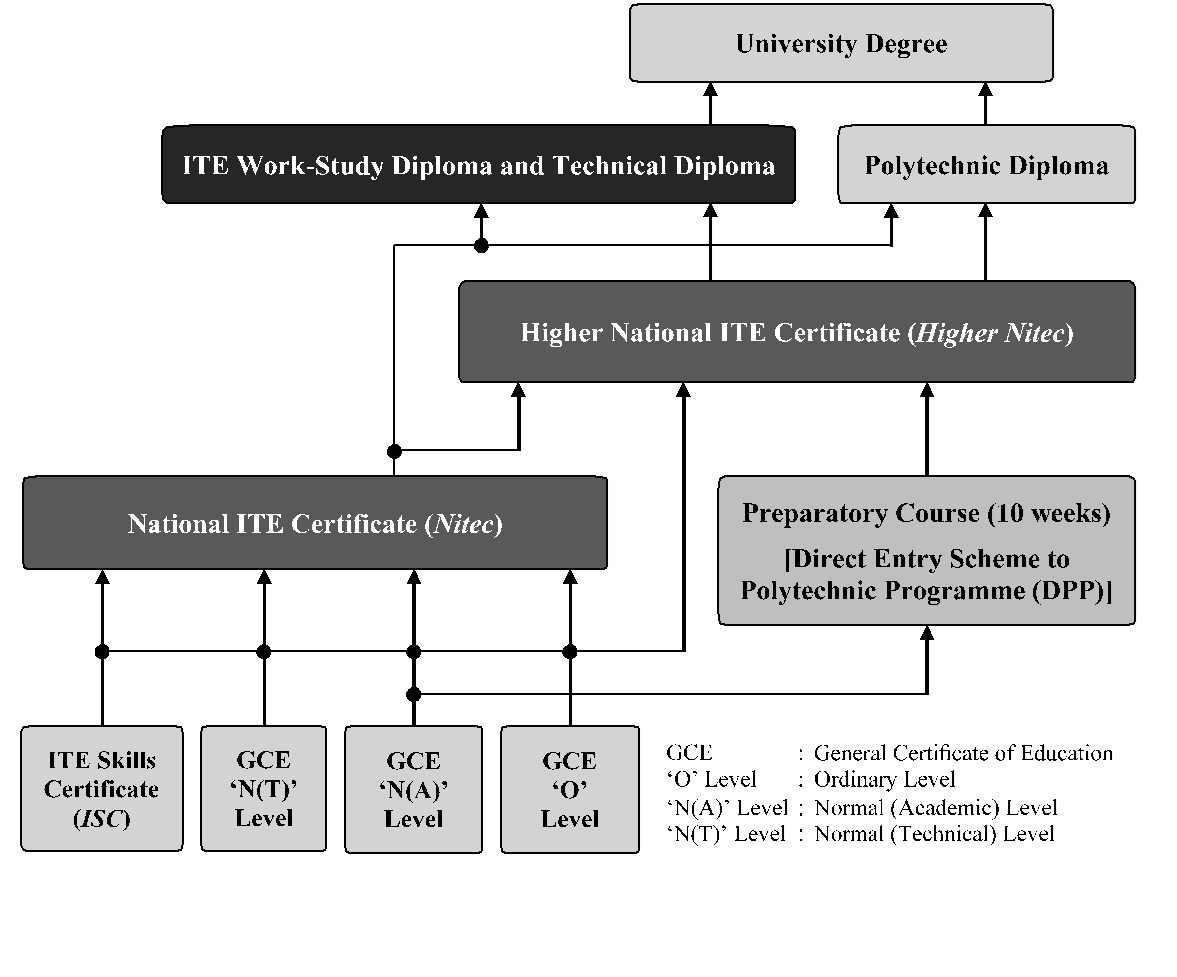
taken from https://www.ite.edu.sg/admissions/full-time-courses/higher-nitec/academic-progression
2) Polytechnic
- Most courses are 3 years, which are further spilt into 2 years of studying and half a year of internship and half a year of final year project
- There are 5 polytechnics in singapore. Subjectively speaking, SP and NP are perceived by the general public to be the better ones and tend to have higher entry requirement for their courses.
- Very popular courses that require very good scores include biomedical science, business, IT/cybersecurity. For eg in 2024, range of Net JAE ELR2B2 is 5 to 12 (SP aerospace electronics), 3 to 7 (NP biomedical science and 3 to 9 (NP banking & finance)
- If your diploma course is related to your university course, you can apply to be exempted from studying specific university modules, allowing you to graduate earlier
Nanyang Polytechnic (NYP) known for digital media/infocomm and nursing
Ngee Ann Polytechnic (NP) known for business
Republic Polytechnic (RP) known for sports sciences
Singapore Polytechnic (SP) known for engineering and life science
Temasek Polytechnic (TP) known for design and law
entry requirement
ELR2B2 (i.e. English Language, 2 relevant subjects and best 2 other subjects) is typically 26 points and below
3) Junior College
They are 2 years programme at the end of which, you take A levels examination, although it is increasingly common for students who do not do well at end of year 1 to retain instead of progressing to year 2. If they do not well in A levels, they will have to retake A levels as a private candidate if they choose to and cannot remain in school.
Only exception is Millennia Institute which offers a 3 years programme at the end of which, you take A levels examination
Comparison of the different junior colleges for their results in A levels
entry requirement
Gross (or raw) L1R5 aggregate score of 20 or better
- ‘C6’ grade or better in O-Level English
- Either a ‘D7’ grade or better in O-Level MTL, a ‘E8’ grade or better in O-Level Higher MTL or a ‘Pass’ grade or better in O-Level MTL B
- Either a ‘D7’ grade or better in O-Level Mathematics or a ‘D7’ grade or better in O-Level Additional Mathematics
CCA grades of A1-A2 will be given 2 bonus points and grades of B3-C6 will be given 1 bonus point.
Calculate L1R5 (For JC Admission)
- L1: First Language (English or Higher Mother Tongue Language)
- R1: First Relevant Subject (Humanities)
- R2: Second Relevant Subject (Mathematics)
- R3: Third Relevant Subject (Science)
- R4: Fourth Relevant Subject (Any additional subject)
- R5: Fifth Relevant Subject (Any additional subject)
Calculate L1R4 (For Millennia Institute)
- L1: First Language (English or Higher Mother Tongue Language)
- R1: First Relevant Subject (Humanities)
- R2: Second Relevant Subject (Mathematics)
- R3: Third Relevant Subject (Science)
- R4: Fourth Relevant Subject (Any additional subject)
Bonus Point Deductions
CCA (Co-Curricular Activities): Students can receive up to 2 bonus points for excellent performance in CCA.
Higher Mother Tongue: Students who pass Higher Mother Tongue can receive 2 bonus points.
Affiliated School: Students from affiliated schools can gain up to 2 bonus points when applying to Junior Colleges.
List of schools with affiliation https://schoolbell.sg/jc-affiliation/
4) International Baccalaureate (IB) diploma
refer to IB programme in secondary school section
5) La Salle & Nanyang Academy of Fine Arts (NAFA)
Both offer diploma course in the arts
https://www.lasalle.edu.sg/
https://www.nafa.edu.sg/
Minimum Educational Qualifications Required
La Salle
- Singapore-Cambridge GCE O-Level with a pass in English at Grade C6 or better, and an aggregate score of 25 points or better in four other GCE O-Level subjects
- GCSE/IGCSE (five subject passes, including English, at Grade 9-4)
- Full-time Higher Nitec/Nitec
- Part-time Higher Nitec/Nitec (minimum GPA of 2.0 for Higher Nitec holders or 3.5 for Nitec holders)
- Singapore Integrated Programme (successfully completed Year 4 or higher)
NAFA
- Singapore-Cambridge GCE ‘O’ Level: Aggregate score of 25 points or better in 4 GCE ‘O’ Level subjects, excluding English.
Applicants who are active in their Secondary Schools’ Co-curricular Activities (CCA) may gain up to 2 CCA points. The CCA points can be used to improve their EQ aggregate score for admission consideration. - Singapore Integrated Programme: Successful completion of Year 4 or higher.
- School of The Arts (SOTA): Successful completion of Year 4 or higher. Institute of Technical Education (ITE):
- Full-time Higher Nitec or Nitec
- Part-time ITE certificate, with a minimum GPA of ≥ 2.0 for Higher NITEC holders or ≥ 3.5 for NITEC holders
Comparison between JC, Poly and IB
Polytechnic is similar to university where you have 2 semesters per year and each semester you study a certain number of modules and examinations/grading for that module is done at end of the semester. JC is essentially secondary school on steroids with the A levels taken at the end of 2 years carrying 100% weightage. IB have 20-30% weightage for course work (projects, presentation, practical work) with the remaining weightage for written examinations. Studying IB can be quite hectic as you juggle both projects and tests at the same time.
Regardless, all 3 options require students to be consistent in their studies. For JC, although examinations is at end of 2 years, the amount of content and workload means you fall behind quickly if you are not consistent.
In the past, JC is definitely viewed as more prestigious than polytechnic although perception is changing in recent years and popular courses in polytechnics have equally competitive entry requirements. There are also multiple cases of poly students who went on to prestigious universities in the news.
Common reasons why students pick JC/IB over polytechnic include shorter duration to enter university (2 vs 3 years) and being undecided on their future career path and wanting to keep their options open.
Roughly 4 out of 5 students from JC and IB enroll in university while 1 in 3 students from Poly enroll in university https://www.straitstimes.com/singapore/how-many-uni-places-for-locals-any-quota-for-poly-grads
There are also cases where students enroll in JC and find it unsuitable and drop out and switch to polytechnic after 1 year and vice versa.
A levels and IB are both equally well recognized locally and globally and should not affect your chances applying for even the most prestigious universities.
It is very hard to find someone who can give a truly objective opinion between the 3 choices, if he goes through one path, he will not be able to experience the other paths and could only share from his own journey. Often times, it comes down to luck, to the teachers and classmates you come across along the way. Best of luck to you or your child’s education journey!
Written and compiled by Ethan Wu Ying Tang
I am a full time tutor for more than 10 years for sec sch maths and science, https://ethantuition.com/
to get in touch with me, whatsapp me at 91275035 or drop a email to ethantuition@hotmail.com
 ethan wu ying tang